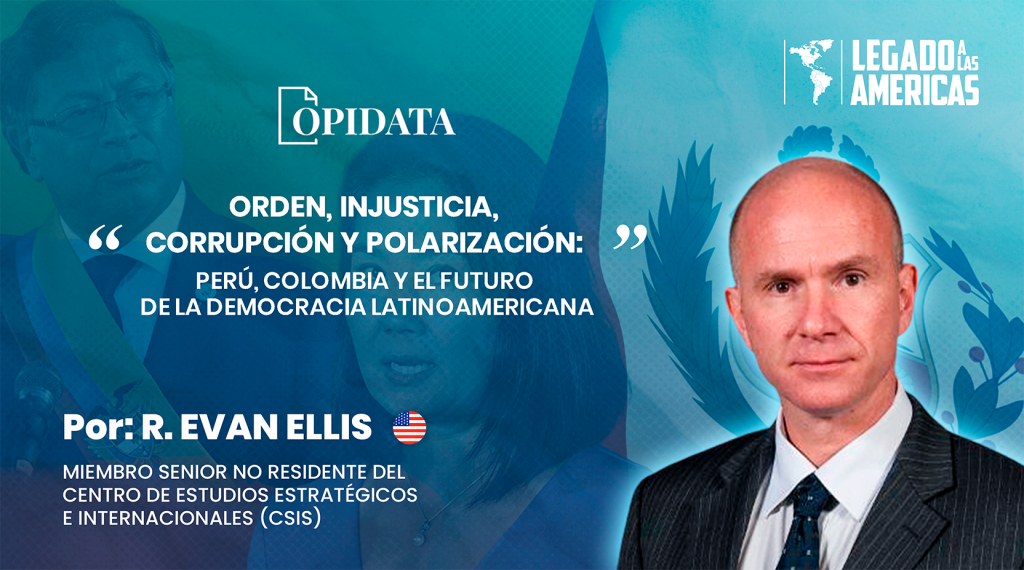
Orden, Injusticia, Corrupción y Polarización – Perú, Colombia y el Futuro de la Democracia Latinoamericana
English Version
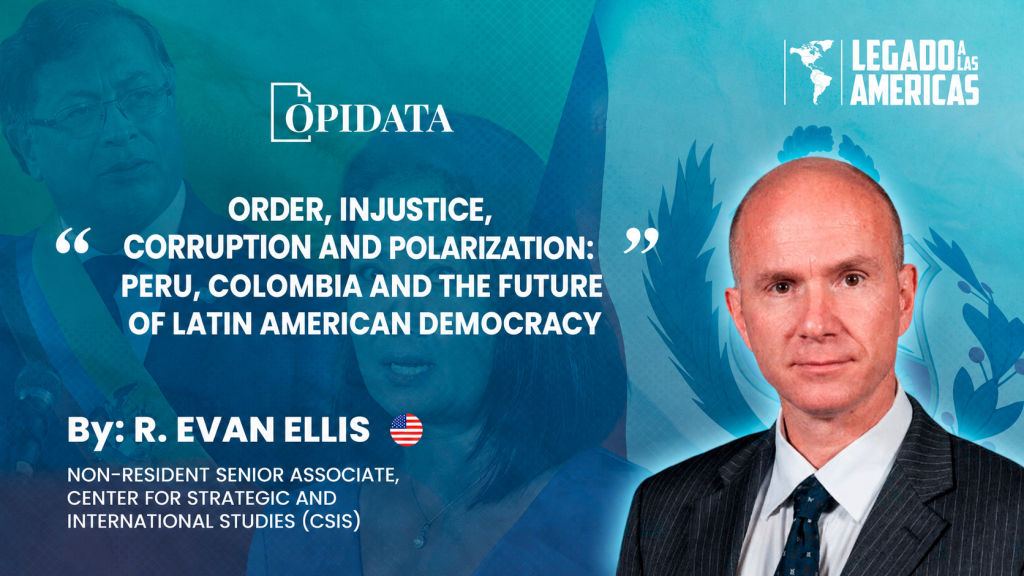
Order, Injustice, Corruption and Polarization – Peru, Colombia and the Future of Latin American Democracy
The recent election of Keiko Fujimori as Peru’s next President, and the victory of Abelardo de la Espriella in the first round of Colombia’s Presidential election are good news for the U.S., and for those countries. Both create opportunities for working more closely together to address criminal groups profoundly undermining democracy, governance, and prosperity in those countries, and through those harms, threatening the United States. Yet both elections also highlight a polarization across the region that must be understood and addressed in the interest of the democratic stability and economic health of the region which most directly affects U.S. security and prosperity.
In the May 31st, 2026 first round of Colombia’s election, De La Espriella won 44% of the vote, significantly outperforming polls, and finishing ahead of Ivan Cepeda, of President Gustavo Petro’s “Historic Pact” party, who obtained 41% of the vote. Center-right candidate Paloma Valencia, who had spent most of the final months in a close race for second with De la Espriella, finished a distant third with a mere 7% of the vote.
De La Espriella’s victory arguably reflects his articulation of a strong message about confronting crime and insecurity, in the context of widespread frustration among Colombians with the deterioration of security conditions and the sense of malaise that have accompanied the disastrous policies of Gustavo Petro. The latter’s failed attempts to negotiate peace agreements with an array of criminal and terrorist groups, and his leniency towards coca growing produced an explosion of cocaine production, criminality, violence and economic fragility, in a country not long before on a promising path towards security and development.
Such disillusionment among Colombians is arguably deepened by ongoing scandals involving political donations to Petro and others from narcotraffickers, indications of drug and alcohol abuse by the President, and negative interactions with the United States seen as humiliations for Colombia, as much as for President Petro himself. In short, Petro’s Presidency focused and magnified Colombians’ frustration with the longstanding corruption and dysfunctionality of their political system, which seems to have reached new heights under his Presidency.
As has occurred in transitions to populist leaders on both the left and right in many other countries, that accumulated frustration positioned a critical mass of Colombians to be receptive to the candidate most strongly projecting strength and change. That positioning helps to explain the fading of more moderate right candidate Paloma Valencia, who was seen by many as lacking a clear plan beyond invoking the successes of Colombia’s iconic former President Alvaro Uribe, with her announced intention to use vinegar to eradicate coca plants generating mockery and internet memes. The frustration of Colombians similarly explains the failure to gain traction by a number of highly-qualified, but more moderate and traditional candidates such as prior Medellin mayor and Antioquia Governor Sergio Fajardo, and former Bogota mayor Claudia Lopez.
In Peru, the victory by Keiko Fujimori in Round 2 of that nation’s June 7th Presidential Elections reflects dynamics similar to those of Colombia. The nation has been beset by an epidemic of criminality in its major urban areas, including brutal murders and extortions, reflecting the interaction of a large, economically marginalized population of Venezuelan immigrants, exploited by criminal groups such as Tren de Aragua, and a flood of money from illicit activities in the Peruvian countryside, particularly cocaine production and smuggling, and illegal mining.
As in Colombia, Peruvian voters have been frustrated by a rash of corruption scandals leading to the removal of Presidents and tainting other leaders on both the left and right. As with Colombians deeply frustrated with President Petro in Colombia, for Peruvians in the center and right, deeply proud of their culture, the behavior of recent leftist presidents invoked reactions of shame, and fear of leftist subversion. Examples include Peruvian President Pedro Castillo, removed and jailed following an attempt to dissolve the national Congress, and Jose Maria Balcazar, who had publicly defended sexual relations between teachers and minor students. In this environment, Peruvians embraced Keiko Fujimori, who channeled the legacy of her father, credited for defeating the Shining Path guerilla movement in the 1990s, even if that legacy was tainted by anti-democratic actions, corruption and human rights abuses. Correspondingly, conservative Peruvians feared that Fujimori’s opponent, leftist psychologist Roberto Sanchez, would bring back the subversive influence of the left, including shadowy figures such as the Cuban-trained Vladimir Cerron.
Nor are the dynamics of elections in Colombia and Peru unique. The victories of right-oriented candidates in recent elections in Ecuador, Chile, and to an extent, Bolivia, have similarly been driven by voter frustrations with insecurity and corruption, and an impulse to block the radical left from power.
In both Peru and Colombia, and in other countries across the region, there are credible reasons for believing that a combination of leftist actors and criminal groups contribute to political destabilization, in a mutually reinforcing coincidence between ideology and a desire to avoid a functional, U.S.-friendly state that would impede their criminal and other activities. The activities of Evo Morales and the cocaleros of Chapare to destabilize the democratically elected government of Rodrigo Paz in Bolivia is one prominent example.
Although the narrative of the rejection of the left is compelling, in Colombia almost as many people voted for Cepeda as voted for De La Espriella, and in Peru, almost as many people voted for Sanchez as for Fujimori. It is important to recognize that the vast majority who identify with leftist politicians from Gustavo Petro and Ivan Cepeda in Colombia, to Roberto Sanchez and Jose Maria Balcazar in Peru, to Evo Morales in Bolivia, base those loyalties not just on material interests, ignorance or being “manipulated,” but also on a particular worldview of who are their allies, the “good guys,” and their adversaries, that it is important not to ignore.
Among the author’s family and friends are gifted Colombians who voted for Cepeda because they felt less threatened by narco-terrorist Cuban subversion than by a candidate with a discourse that seemed hateful and divisive, supporting a system in which the wealthy “families” and elites of “stratus six” have rigged the system against them.
In a similar way, it is important to understand those in Peru from the marginal barrios to the Andean highlands, to the “caviar” left “pituka” elites of Lima, who saw Sanchez as their champion, and saw the Fujimori’s as part of the problem. Both populations will play an important role in the future stability, governance and health of democracy in Colombia, Peru and the region.
Presuming that De La Espriella prevails in the June 21 2026 second round of Colombia’s elections, both Colombia and Peru will move into a new phase, in which the success of new right-oriented pro-U.S. governments will depend on two different, and equally difficult imperatives: mobilizing the resources of the state to address the challenges of organized crime, insecurity and corruption, and winning the confidence of the “almost half” of each electorate that did not vote for the candidate elected to govern. In each country, decisive leadership does not have to preclude decency and inclusion, and in the long run, the stability of each new government and the success of its program arguably will depend on it. Moreover, while the United States should embrace the increased willingness of the new Peruvian and Colombian government to work with it, it should take care not to appear to take sides in partisan attacks by those governments against ideologically opposed segments of their own populations.
Both new governments will also face important choices regarding how to adjust their relationships with the People’s Republic of China in ways that preserves legitimate commerce and investment, yet which also ensures greater benefit to the country from such transactions through increased transparency, more capable institutions and oversight, and the rule of law.
For its part, the U.S. should be prepared to move quickly to leverage the opportunities offered by its partners’ expanded willingness to cooperate with it in security and other affairs, locking in those benefits by helping those partners to succeed.
Possible ways for the U.S. to do so include expanded assistance in combatting criminality and corruption, consistent with actual partner needs, and respectful of partner sovereignty. Pursuant to analysis and dialogues with those partners to better understand what is needed and appropriate, such help may include expanded intelligence sharing, training, technology, and in some cases, equipment.
Beyond security, the U.S. should also be positioned to step up private sector investment through vehicles such as the expanded Development Finance Corporation and U.S. Export-Import bank, support for multilateral financing to help partners cover liquidity gaps, strengthen their currency and build investor confidence as they transition to more market-oriented, investment friendly, innovation-nurturing policies.
For the U.S., such modest investment in helping Peru, Colombia and other receptive governments succeed, bolstering their stability and pro-U.S. orientation, and inoculating them against initiatives of the PRC and predatory Chinese companies, is central to enlightened U.S. self-interest.