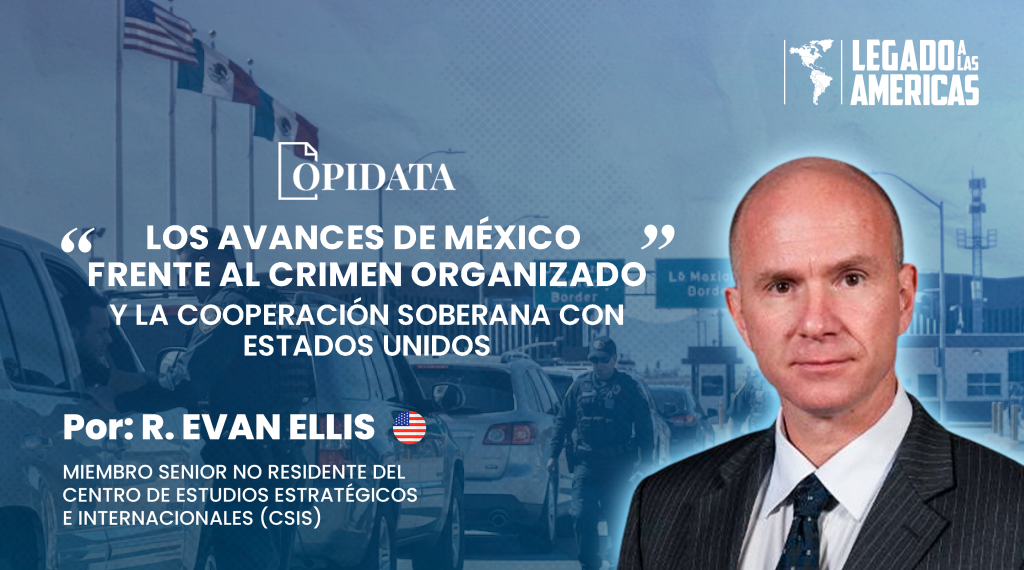
Los avances de México frente al crimen organizado y la cooperación soberana con Estados Unidos
English Version
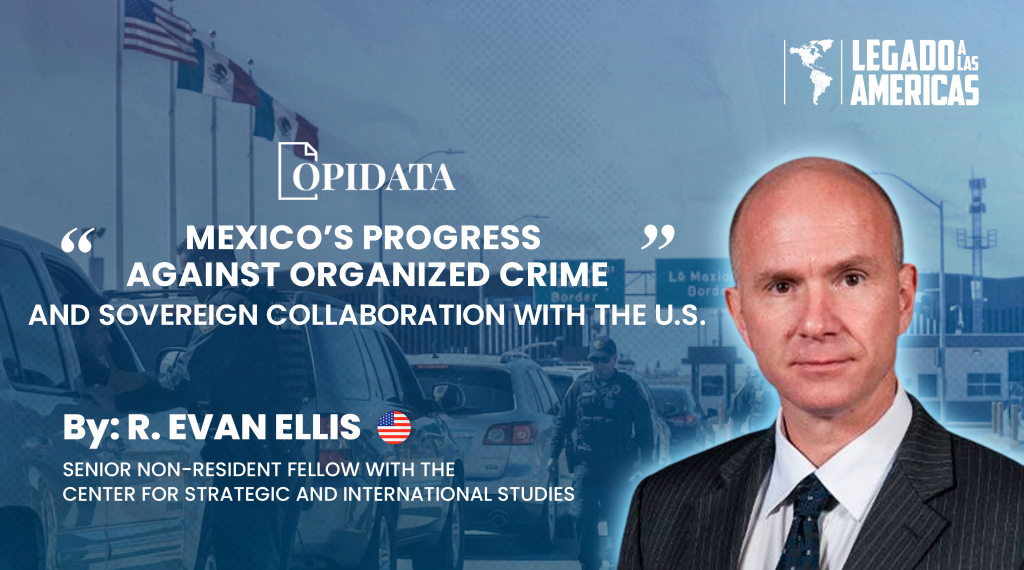
Mexico’s Progress Against Organized Crime and Sovereign Collaboration with the U.S.
The May 2026 U.S. Justice Department indictment of sitting Sinaloa Mexico governor Ruben Rocha Moya and nine others focused attention on Mexico’s serious corruption problem, driven by and helping to enable criminal groups in the country.
The record of corruption penetrating to the highest level in Mexico is substantial. It includes the 2024 conviction of Genaro Garcia Luna, Attorney General during the 2006-2012 administration of Felipe Caleron, the 2021 conviction of Tomas Yarrington Ruvalcaba, Governor of Tamaulipas from 1999-2005, conviction of his successor, Eugenio Hernandez Flores, the 2012 conviction of former Quintana Roo governor Mario Villanueva Madrid, the arrest and extradition to Mexico of Robert Borge Angulo, Governor of Quintana Roo from 2011-2016, and Cesar Duarte Jaquez, Governor of Chihuahua from 2010-2016. It also includes the U.S. imposition of sanctions on, and charges against Robert Sandoval Castaneda, governor of Nayarit from 2011-2017, as well as the October 2020 U.S. arrest of Mexican Army head, General Salvador Cienfuegos. The Cienfuegos case created particular consternation in Washington when, following U.S. return of Cienfuegos to Mexico at the latter’s insistence, the Mexican government of then-President Andres Manuel Lopez Obrador (AMLO) dismissed all charges against Cienfuegos and openly published the case against him, putting sources and methods used by the U.S. at risk. Indeed, AMLO himself was suspected to be collaborating with the Sinaloa Cartel, making so many public visits to the mother of convicted Sinaloa boss Joaquin “El Chapo” Guzman in Badiraguato that the town erected a billboard welcoming him.
The attention to high-level Mexican corruption and the flow of fentanyl and other drugs from Mexico into the U.S. has led the Trump Administration to make statements interpreted as threatening unilateral U.S. strikes against those cartels in Mexican territory, prompting strong if diplomatic responses by Mexico’s current President, Claudia Sheinbaum, that such actions would be completely unacceptable.
The current discourse about corruption and threats of unilateral U.S. action, even if taken out of context, overshadows the important increase in actions by the Sheinbaum administration, vis-à-vis her predecessor AMLO, against criminal groups and public insecurity, the notable successes of those initiatives, and the expanded, yet always significant, cooperation with the U.S. in that struggle. The author was in Mexico during the end of July 2026, speaking with security experts and others about the country’s organized crime challenges. This work reflects those interactions and supporting research.
Mexico’s Efforts Against Organized Crime and Collaboration with the U.S.
Since its arrival, the Sheinbaum Administration has stepped up enforcement actions against major cartel leaders. Its most notable victory was arguably the February 2026 operation, with some U.S. intelligence support, terminating Nemesio Oseguera Cervantes (“El Mencho”) leader of the Jalisco Nuevo Generacion (CJNG), Mexico’s bloodiest and most powerful cartel.
More broadly, Sheinbaum’s head of Public Security, Omar Garcia Harfuch, an experienced police officer who narrowly survived a June 2020 assassination attempt by CJNG, when he was Mexico City’s security chief, has quietly worked to create intelligence and investigative capabilities within his “Citizen Security Secretariat” (SSPC), including a small new Investigative police organization.
Between October 2024 and February 2026, the Mexican government reports that the Sheinbaum Administration has dismantled more than 2,300 drug labs, more than the total during the prior AMLO Presidency. During that period, the Sheinbaum government also reports seizing more than 24,000 firearms, and arrested 907 people for extortion, a crime which has increased 50% since 2015. Between October 2024 and June 2025, the Sheinbaum administration further seized almost 60 tons of cocaine, roughly 20-40% higher than average seizures during the AMLO sexenio.
With respect to corruption among public officials, Operation Enjambre, launched by the Sheinbaum government in November 2024, by July 2026 had arrested 85 public persons, including 19 current and former mayors, although experts consulted for this work suggested that the scope of the operation is limited.
Although the penetration of the Mexican state by organized crime remains substantial, the country’s homicide rate has decreased significantly during Sheinbaum’s sexenio. According to Mexico’s public security organization CESNSP, murders declined from 30,060 in 2024, to 23,609 in 2026, a decrease of 21.5% to 17.7 per 100,000. Although some consulted for this work insist that murders have not improved, but more are being counted as “disappeared.”
Cooperation with the United States has also been notable. Sheinbaum has conducted expedited extraditions of 92 persons to the U.S. The Sheinbaum government has authorized flights of U.S. drones over Mexican territory and has deployed the National Guard to help control flows of migrants through Mexico to the U.S.-Mexico border. Mexico has at least 12 military liaison officers in various U.S. institutions, and conducts regular staff talks, exercises, intelligence sharing, and other coordination with its U.S. counterparts.
Nonetheless, Sheinbaum’s current refusal to extradite Ruben Rocha Moya, and AMLO’s public reappearance to sharply criticize the U.S. request, has fueled speculations that the governing party fears what extradited senior MORENA officials could reveal about AMLO himself, or other senior Mexican officials, if they cooperate with U.S. authorities.
Despite the progress the Sheinbaum Administration is making against organized crime and insecurity, the country continues to face a labyrinth of challenges as multiple, often fragmented groups compete for key territory and narcotrafficking routes. Due largely to actions by Mexican authorities, the status of both of Mexico’s two largest, internationally connected groups, the Sinaloa federation, and CJNG, both designated in February 2025 by the U.S. as Foreign Terrorist Organizations (FTOs), are in flux.
The arrest in the U.S. of Ismael El Mayo Zambada in July 2024 took out the leader of one of Sinaloa’s two major factions. The cooperation and voluntary surrender of Joaquin Guzman Lopez in El Mayo’s capture, coming after the January 2023 arrest of his brother Ovido Guzman Lopez, put two of the four members of the other faction, the “Chapitos,” in jail and probably cooperating with U.S. authorities regarding the operation of the two remaining brothers, Ivan Archivaldo and Jesus Guzman Lopez.
Concurrently, the previously noted takedown of “El Mencho” created a similar succession struggle in that organization, likely dominated by El Mencho’s stepson, Juan Carlos Valencia Gonzalez, but possibly also including Richardo Ruiz Velazco (“Double R”) head of an elite CJNG special forces group, among others.
Beyond these two major federations Mexico’s criminal landscape features an array of armed groups who have evolved out of other legacy groups such as the Beltran Leyva organization, the Gulf Cartel and their former military wing, the Zetas, each of whose leadership has also been decimated by operations by Mexican security forces over the past two decades. Many of the most significant of the groups who have emerged from these have been designated by the U.S. as FTOs, including the Northeast Cartel (a Zetas splinter), La Nueva Familia Michoacana, Carteles Unidos (a Michoacan-based coalition of mostly former vigilante organizations), the remnants of the Gulf Cartel, and in July 2026, the Viagras (based in Michoacan), and the Juarez Cartel (based on the Arellano Felix organization dominating the Juarez plaza in Chihuahua).
Major Criminal Domains of Focus for the U.S.
Drugs. Within the global drug trade, Mexico is important as both a source and transit zone for multiple types of plant-based and synthetic drugs. The former includes cocaine, generally smuggled from Colombia, through various routes in Mexico, to the U.S. An important part of the cocaine sent from Pacific coast ports in Colombia and Ecuador land on the Pacific Coast of Mexico before being smuggled overland into the U.S. Secondarily, heroin is produced in Mexico, largely in Guerrero, and the “Heroin Triangle” region from Sinaloa to Durango to Chihuahua, although fentanyl has substantially displaced opioid production in recent years. Some heroin is also produced in the San Marcos area of neighboring Guatemala, and moved through Mexico into the U.S. Mexico has also historically exported Marijuana to the U.S., although with partial legalization of Marijuana in the U.S. in recent years, this has decreased in relative importance vis-à-vis other categories of drugs.
With respect to synthetic drugs, both fentanyl and methamphetamines are chemically manufactured and often pressed into pill form in Mexico, mostly in the state of Sinaloa, albeit some also in Durango. Almost all are made from chemical precursors obtained from PRC-based companies. Fentanyl, which has increased in importance in Mexico’s drug trade since the 2010s, is primarily demanded by the U.S. market, while other synthetic drugs are more destined for Europe, often with the facilitation of Europe-based criminal organizations operating with representatives in Mexico and elsewhere.
Contraband Fuel. Although U.S. attention toward and cooperation with Mexico has focused primarily on the flow of drugs and immigrant smuggling and trafficking, Mexico’s multi-billion contraband fuel industry (“huachicol”) has received increasing U.S. focus in recent months, particularly where cross-border flows of stolen or other contraband fuel enter the U.S. market, particularly in states such as Tamaulipas, or where those flows have been important funding sources for powerful criminal groups such as CJNG. Huachicol fuel theft and diversion is estimated to cause $1.2 billion in losses to Mexico’s national oil company PEMEX. It is concentrated in the states hosting Mexico’s major oil installations, such as Guanajuato, Tabasco, and Veracruz. It is increasingly dominated by CJNG, although other criminal groups play a role. On June 30, 2026, the U.S. Treasury indicted two nationals and sanctioned nine Mexico-based entities tied with fuel theft in Mexico, with a focus on cross-border illicit fuel flows empowering CJNG.
Regional Patterns of Violence
Mexico’s current patterns of homicides and violence do not so much indicate the strongholds of its criminal groups, but rather, those areas, often at the geographic boundaries between groups, where that control is most contested, or where fights over lucrative plazas, ports, or logistics corridor are occurring.
Colima. This small state on Mexico’s Pacific coast currently has the country’s per capita homicide rate, 81.1 per 100,000 in 2025. As with many other Mexican states, that actually reflects an improvement, with murders in Colima falling 25.8% from 2024. Moreover, the high per capita homicide rate is notable within its small population, even though the state’s 611 homicides do not rank it among the Mexican states with the greatest number of murders in absolute terms. The high homicide rate in Colima reflects the state’s location at the approximate geographic boundary between Mexico’s two most powerful cartel federations, Sinaloa and CJNG. It is also host to the Port of Manzanillo, important for the importation of precursor chemicals for synthetic drugs such as fentanyl, as well as for other criminal activities. Breakaway criminal factions such as the Mezcales also complicate the criminal landscape.
Morelos. This small state has Mexico’s second highest per capita rate of homicides, 54.4 per 100,000. Whereas Colima features the port of Manzanillo, the criminal struggles in Morelos arguably owe to the state’s central location, both adjacent to Mexico City, Mexico’s industrial heartland, the State of Mexico, while also geographically a transport corridor to the Pacific. Morelos’ central location also puts it at the blurred geographic boundary between multiple powerful criminal organizations, including those in Guerrero and the State of Mexico, the country’s industrial heartland. Many criminals displaced by Mexican operations in other states, including Guerrero and the State of Mexico, have reportedly moved to Morelos. Indeed, the state currently has 11 criminal groups competing for control over a relatively small area, including the Sinaloa Cartel, CJNG, La Familia Michoacana, Guerreros Unidos, Unión Tepito, Los Tlacos, Los Mayas, Los Linos, La Empresa, and Los Rojos, among others.
Guanajuato. The state leads Mexico in the absolute number of homicides, 2,539, and ranks fourth in per capita homicides at 63.7 / 100,000. This situation is, nonetheless, an improvement, with a 19.4% decrease from 2024-2025. The high level of murders reflects the presence in the state of the Salamanca refinery, for years an object of struggle between CJNG and the Santa Rosa de Lima cartel to steal and divert petroleum, as a key site in the multi-billion-dollar illegal fuel (huachicol) industry fed by the refinery. Guanajuato also lies on a key industrial corridor, and is host to multiple other groups, including Sinaloa; Zeta cells, Union de Leon.
Chihuahua: The state has the second highest absolute number of murders during the past year, with 1,797 killings and ranks 4th in per capita homicides at 44.4 per 100,000. As with Baja California, Chihuahua is the site of an important drug plaza providing access to the U.S. market, Ciudad Juarez. As such, the state has been an object of struggle between the Juarez cartel, its armed wing La Linea, Sinaloa cartel elements and multiple others groups, including Los Viagras, Los Salgueros, La Gente Nueva, Las Mezcales, and La Empresa, among others.
Sinaloa. In 2025, homicides in the state leapt 66.6% to 1,656, giving the state the fourth highest number of homicides, and the third highest per capita murder rate in Mexico at 52 per 100,000. The increase in homicides arguably reflects the previously noted elimination of key Sinaloa leaders, and the struggles for control of the state’s key plazas which that spawned.
Baja California. The state is currently the third highest in Mexico in the absolute number of homicides, 1,714, and fifth nationally in per capita homicides at 41.5 per 100,000. The fight by multiple groups to control portions of the state arguably reflects its strategic position as an entry point to the highly populated and affluent southern California, including the Tijuana Plaza. In addition, Baja California has a substantial retail drug market that criminal groups compete to dominate. The state is also the site of struggles between the remnants of the Sinaloa cartel, and the legacy Arellano Felix/Tijuana Cartel which historically had a significant role in controlling the Tijuana plaza.
Michoacan. The state’s 1,267 homicides in 2025 rank the state it 7th highest nationally. It is home to the strategic port of Lazaro Cardenas, also used for narcotrafficking and other criminal activities, and has been the site of some of the most intense combat operations in Mexico. Many of the battles involve CJNG, whose former leader “El Mencho” was born in Aguililla, Michoacan, near the border with the group’s namesake operating base of Jalisco. In different Michoacan geographies, CJNG faces off against an array of other groups, including Carteles Unidos and La Nueva Familia Michoacana, among others. The level of military struggle in the state is notably advanced compared to some others. Michoacan has seen employment of combat drones, homemade armored vehicles, and an increasing number of improved explosive devices (IEDs), among other lethal instruments.
Conclusion
Mexico is not, technically, a state “run by the cartels” in need of unilateral U.S. military action. Rather, it is a vitally important security and economic partner with whom the U.S. shares a 3,110-kilometer land border. Its government is making commendable, if not necessarily decisive, advances in combatting grave challenges from an array of groups, which are funded or directly by drugs bought by the U.S. and Europe. Mexico’s government is waging those battles even as it is impaired at the highest levels by the significant corruption that those illicit flows have wrought. Now, more than ever, Mexico needs the respectful partnership with and support of its neighbor to the north. Working together to make the deeply interconnected neighborhood that both share more secure and prosperous in the enlightened self-interest of both.