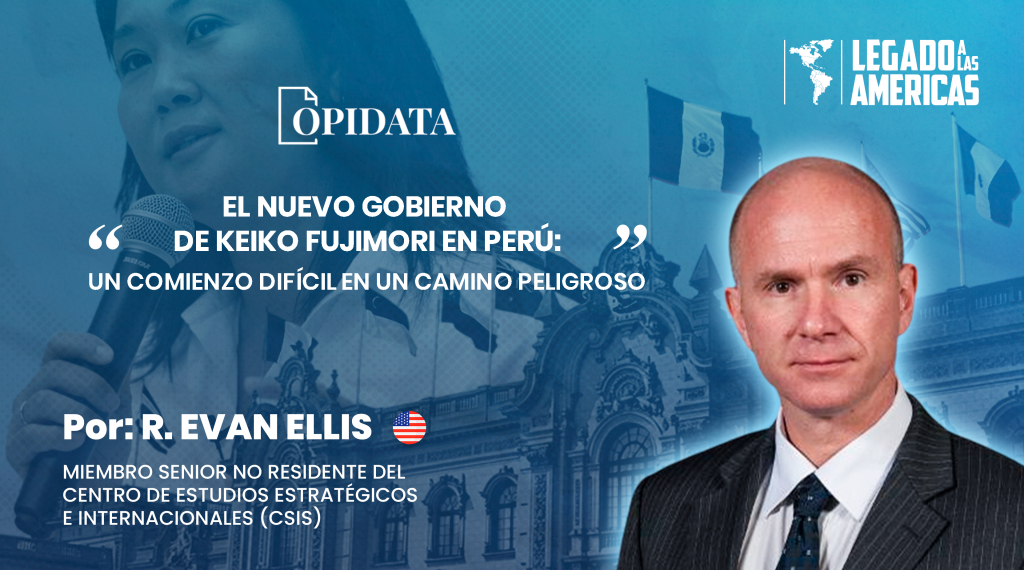
El nuevo gobierno de Keiko Fujimori en Perú: un comienzo difícil en un camino peligroso
English Version
Keiko Fujimori’s New Government in Peru: A rough start on a perilous journey
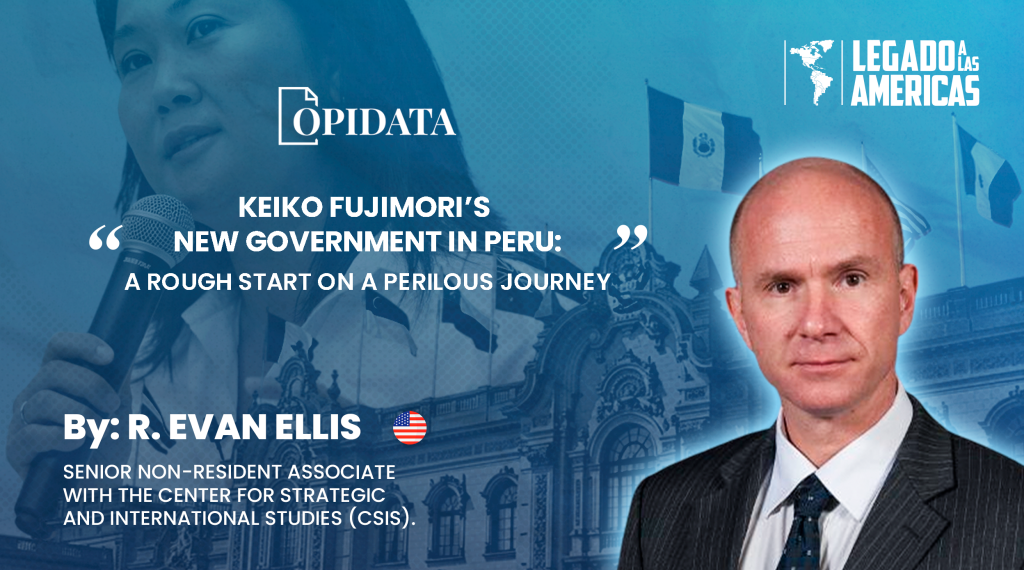
On July 28, 2026, Keiko Fujimori was inaugurated as Peru’s 10th President in the last 10 years. Her administration, which faces grave problems of organized crime, public insecurity, corruption and political fragmentation, is off to a rough start. It has been tainted by public discontent over some of her cabinet picks, modest delays in presenting her legislative agenda to the Congress, and a sense among many Peruvians that Keiko is more a consensus-seeker, and less the decisive leader in the image of her father, that many hoped she would be. Her Prime Minister, Luis Galarreta, is politically sophisticated, yet regraded by some as too sympathetic with Peru’s “caviar” leftist elites than Keiko, and too tepid in communicating the President’s agenda.
Counterbalancing such concerns, Keiko has appointed a respected technocrat, Elmer Cubas, as Finance Minister. Her Foreign Minister, Carlos Espa, has taken steps to rebuild Peru’s relationships with the United States, Mexico and its more immediate neighbors such as Chile. Keiko’s government has also communicated a reasonable vision of her administration’s priorities.
In light of the nation’s challenges, Keiko’s government has submitted a request to the Peruvian Congress for 120 days of extraordinary legislative authority. It is not certain, however, how much and what part of the request the new, left-dominated Chamber of Deputies will give her new government, or how long they will delay in deciding.
The present article examines the key challenges and strategic decisions for the Keiko Fujimori government, with an emphasis on transnational organized crime and insecurity, the country’s relationships with the People’s Republic of China (PRC) and the United States, and questions of public corruption and governability. It is based on the author’s conversations with subject matter experts during his August 2026 visit to Peru and supporting research.
Organized Crime and Insecurity
Public discontent with organized crime and insecurity, and the perception that Keiko would address it through policies resembling the “strong-handed” approach of her father, was a key factor in her election. Peru’s criminal dynamic reflects a synergy between substantial illicit economies in the countryside, fueled by coca growing, illegal mining and timber, and equally criminal economies in urban areas where profits from illegal mining, coca and illegal logging in the countryside is laundered through construction and largely informal commercial activity. The urban dynamic is complicated by at least 1.5 million Venezuelans and other displaced and marginalized, who are extorted, robbed, and exploited by violent gangs such as “Tren de Aragua” the “Pulpos,” Ecuador’s “Choneros,” and smaller groups involving Colombians, more focused on extortion and usurious lending known as “gota-a-gota.”
The 85,000 hectares of coca under cultivation in Peru, as reported by the nation’s counterdrug organization DEVIDA, is second in the world only to Colombia. It includes illicit production not only in the Apurimac, Ene and Mantaro river valleys (the “VRAEM”) but also increasingly in lowland areas in Loreto and Ucayali, particularly along the borders with Colombia and Brazil. Some coca is even found in the southeast in Puno, near Bolivia.
Illegal mining continues to be a problem throughout the country, particularly in Madre de Dios, Junin, and in the north, in areas such as Pataz and La Rinconada. International actors such as Brazil’s First Capital Command (PCC) and Red Command (CV) are reportedly involved in both such mining activities, and in cocaine production and transport. Illegal timber activities are particularly pronounced in the remote eastern departments of Loreto and Ucayali where there are synergies in human networks, logistics, and money with the illicit cocaine economy. According to some consulted for this work, illegal mining conveys particular risks to Peru’s democracy because it is tied to economic interests to many former and current congresspeople, local politicians, and other elites.
Complimenting such criminality and weak state presence, the Peruvian terrorist group Shining Path continues to have a presence of approximately 250 persons, concentrated in the VRAEM, particularly in Vizcatán. The group reportedly helps to protect and is funded by criminal activities in the region, especially coca growing.
Regarding Peru’s urban challenges, during 2026, local media reported high profile extortion cases not only in poor suburbs of the greater Lima area such as the northern cone and Callao, but also elsewhere in the country, particularly in the Departments of La Libertad and Piura.
Compounding problems of insecurity and the illicit economy, this year is expected to bring a particularly intense “El Nino” phenomenon, with elevated water temperatures affecting fishing, and record precipitation harming agriculture and causing flooding and mudslides affecting the livelihood of an estimated 1.2 million Peruvians.
Peru’s outgoing government had made modest progress against organized crime and insecurity. The 85,000 hectares of coca under cultivation noted previously, was 5.8% less than the prior year, the third annual decline. The homicide rate, 7 murders per 100,000, is approximately 7% lower than it was in 2025, and substantially down from its peak of 10.1/100,000 in 2024. Peru’s National Police reports that extortions in the first quarter of 2026 were 46% lower than the first quarter of 2025. Several consulted for this work, however, cautioned that the reporting of extortions may have dropped as gangs have consolidated control of neighborhoods.
Building on planning that probably occurred before Keiko’s inauguration, the military and police launched multiple significant operations against organized crime. On the day after Keiko’s inauguration, Peruvian forces in the VRAEM killed Comrade Richard, a key leader in the Shining Path terrorist group. Keiko herself followed up the achievement with a personal visit to the region on August 1. Other major Peruvian operations in the weeks following her inauguration include “Jaguar,” an action against cocaine traffickers in Ramon Castilla, near the triple frontier where Peru borders Brazil and Colombia. In recent weeks, the Peruvian military has also launched major operations against illegal mining in Pataz and Madre de Dios, although some of Peru’s biggest illegal mining areas, like La Rinconada, have received much less state attention.
In response to public insecurity, Keiko’s government rolled out “Plan Shield,” notably using a title building off of the U.S.-led “Shield of the Americas.” The operation surged an additional 4,000 Peruvian national police to the greater Lima area, supported by military forces. Persons consulted for this work noted that past Peruvian governments have regularly conducted such operations, and thus far, did not see a major change in the security situation.
Keiko’s government is also moving proactively to prepare for the intensification of this year’s El Niño phenomenon. The government has earmarked 450 million soles to strengthen 80 bridges identified as vulnerable and fortify 380 “points of intervention,” and is focusing on preparatory measures in 607 districts identified as particularly vulnerable. Those consulted for this work, however, expressed concern whether the government could adequately fund and execute at least a minimum response capability to the flooding and mudslides expected to impact communities on the northwest coast. They noted that, by contrast to organized crime, which Peruvians have become somewhat accustomed to, the government’s response to El Nino challenges would directly shape citizen perceptions of its competence in addressing urgent basic needs of its citizens.
While such activities indicate that Keikos government is taking steps to address the nation’s grave security challenges, multiple persons consulted for this work expressed concerns about Keiko’s selection of security sector leaders, and whether she had the attributes of decisive, charismatic leadership many Peruvians valued in her father. Key doubts include whether the new Defense Minister, Rafael Belaunde Llosa, a prior presidential contender perceived by some as a progressive who has been critical of the military, has adequate experience for the position. Some consulted for this work expressed concern with his publicized ties to the Minera Poderosa mine in the north of the country, where the military is conducting significant activities to combat illegal activity. Others raised questions of the Minister’s family and other ties to Chile, Peru’s historical geopolitical rival.
Beyond Defense Minister Belaunde, colleagues noted that the selection of Interior Minister Cesar Astudillo, a well-respected retired Army General, created discomfort among some in the Peruvian National Police (PNP), accustomed to having one of their own in the position, particularly when he named a number of former Army colleagues to key Interior Ministry positions.
Other leadership selections, however, have received more positive evaluations, including that of retired General Hugar Cornejo Valdivia, to head the national intelligence service DINI. Cornejo previously led the organization under former Presidents Martin Vizcarra and Francisco Sagasti. Keiko reportedly puts great trust in him, reportedly tied to his time working with Keiko’s father when he was an academic dean, when Keiko was a young girl. Some consulted for this work, however, expressed concerns over Cornejo’s delicate state of health, and whether he would have the time and energy to implement significant reforms needed at the DINI to strengthen its analytical capabilities and give it more of a national strategic intelligence focus.
China and the US
The Keiko government’s navigation between improved relations with Washington and issues of influence and strategic risks raised by Peru’s deep commercial ties with the PRC is likely to be a defining foreign policy challenge of her presidency. Keiko has committed to strengthening ties with Washington, including joining the Shield of the Americas coalition. Her declared intention to increase the use of the military in responding to internal security challenges will compliment ongoing commitments such as Peru’s purchase of U.S. F-16 fighters and an associated support package to fortify ties with Washington.
PRC commercial activities and human networks in Peru, by their size and nature, will continue to cause concern for Washington, but will also be difficult for Keiko’s government to reduce or mitigate. Peru’s current Defense Minister was reportedly hosted in the PRC, before being officially named to the post, and various current Peruvian legislators have been invited.
Other dimensions of the PRC challenge include the ongoing expansion of the Chancay megaport, operated exclusively and with little Peruvian administrative supervision, by the Chinese logistics giant COSCO. During wartime, COSCO’s operation of the port with a willing or incapable future Peruvian government, could allow the People’s Liberation Army (PLA) Navy to use it to resupply its warships for combat against the U.S. in the Eastern Pacific. A Peruvian security analyst consulted for this work believes COSCO employs hundreds of Chinese security personnel at the port.
Chancay is becoming an increasingly important port for importing products from the PRC, raising transshipment challenges for entities importing Chinese goods or components through the port, then exporting them to the US tariff free under the U.S.-Peru Free Trade agreement.
In peacetime, the scale, automation and other cost advantages of COSCO operations at Chancay could help the Chinese to beat out transpacific shipping competitors such as Maersk and Mediterranean Shipping from transpacific routes, giving the PRC leverage not only through the dominance of transpacific service from Peru, but also service from other Latin American Pacific ports through Chancay as it becomes a major reginal hub. Construction of a proposed transcontinental railroad connection from Brazil over the Andes to Chancay would further expand PRC commercial leverage across the continent.
China’s leverage in Peru also extends far beyond Chancay. The PRC is the biggest investor in Peru’s mining sector. It also controls 100% of electricity distribution in the greater Lima area, is one of Peru’s biggest oil producers, and has a substantial presence in Peru’s construction industry, with hundreds of projects, and is involved in a range of other commercial activities in the country. Chinese infrastructure and products dominate the telecommunications sector. Leveraging its digital presence into intelligence collection opportunities, the PRC government reportedly donated Xiaomi cellphones to all of the aides in Peru’s prior Congress.
Beyond such infrastructure vulnerabilities, the PRC is also becoming an important destination for select Peruvian agricultural products. Peruvian blueberry exports to China, for example, increased by 86% in 2026 over 2025 alone.
In military affairs, the PRC has significant influence through the informal networks it has built from past arms sales and the numerous Peruvian military officers and others who have traveled to the PRC. As one of my Peruvian retired military colleagues commented, “we get seduced by all of the attention and trips to China.”
Complimenting such trips, the People’s Liberation Army (PLA) currently has two Coronel-level students in the Peruvian Army War College, and another two in the Center for Higher Military Studies (CAEN) . During my time in Lima, a group from class were reportedly planning to visit the COSCO-controlled port of Chancay, facilitated by those PLA students and the Chinese embassy.
The PRC has also sold Peru military equipment from Beiban, Shanxii and Dong Feng trucks to 27 Type 90B multiple rocket launcher vehicles. It also has access to data from the PeruSat 1 satellite, and has regularly sent delegations to Peruvian military institutions such as CAEN. Still, the Dong Feng trucks and the Type 90B rocket launcher systems are reportedly infamous within the Peruvian military for their numerous problems and poor quality.
Beyond its military activities, the PRC regularly hosts Peruvian Congressional delegations and other politicians, journalists, think tank professionals and others in China. Similarly, it maintains relations with China-facing businesspersons in the country through institutions such as the Association of Chinese Enterprises in Peru (ACEP) and the Peru-China Cultural Association (APCH).
With respect to relations with the US, Peru’s Foreign Minister, Carlos Espa is already facilitating stronger ties. Although not a career diplomat, he is a journalist who not only grew up in an elite, internationally oriented environment, but also worked in a senior public relations support position in the U.S. embassy in Lima. The experience reportedly has given him first-hand knowledge of the U.S. and its diplomatic system, as well as international diplomacy. Espa was also a contender in the 2026 Presidential race, where he was widely respected for his good ideas. He reportedly distinguished himself for taking a courageous political position, criticizing leftist candidate Jorge Nieto for his hesitance to reject working with parties with terrorist ties.
Although Keiko herself may not have the past personal connection with President Trump that has facilitated the relationship that other Latin American leaders have, Espa’s knowledge and ties will likely help Peru navigate sensitivities with Washington. During my visit, Espa also distinguished Peru in ways favorable to Washington by breaking ties with Iran in an action independent of, but strongly supportive of US objectives.
To the extent addressing Washington’s concerns means impacting activities by the PRC and its companies, however, the situation for Keiko may be more complicated. The powerful role of PRC-based entities purchasing Peruvian goods, but also operating key sectors of the Peruvian economy and exercising influence networks through both legitimate and corrupt relations with the nation’s politicians, government personnel and businesspeople, will make it difficult for Keiko to address Washington’s concerns.
Corruption and Governance
As Keiko’s administration continues to move forward, her ability to navigate the corruption and governance challenges deeply rooted in the Peruvian system are likely to be key factors impacting her success.
In Transparency International’s index of self-perceptions of corruption, in 2025, Peru came in 130th of 182 countries surveyed, one of the worst in the region. Corruption is regularly found in Peru’s national police and prosecutors. It has repeatedly played a role in the paralysis and ouster of Peruvian Presidents. These included corruption-related convictions of Keiko’s own father Alberto Fujimori, as well as Presidents Alejandro Toledo, Ollanta Humala, Martin Vizcarra, and Pedro Pablo Kuzynski (charges against the latter were ultimately dismissed). An unexplained bag of cash was found in presidential bathroom of Pedro Castillo’s chief advisor, Bruno Pacheco. Dina Boluarte and transitional presidents Jose Jeri were both removed through votes tied to corruption charges, although neither was convicted. In 2019, Keiko Fujimori herself was put in preventative detention on never proven corruption charges, an experience that reportedly affected her deeply.
A Peruvian colleague consulted off-the-record for this work wondered whether the “deals” that Keiko could have had to make with the corrupted establishment would prevent her from taking needed steps that challenge those interests.
Although Peru’s Congress continues to be fragmented across multiple parties, Keiko’s Popular Force party does have a strong plurality in both houses of the new body. Nonetheless, competitors on both the right and left will create political hazards for her. On the far left, these include figures such as Alfonso Lopez Chau, “Good Government” party head Jorge Nieto Montesinos, jailed former President Pedro Castillo, and leftist candidate Roberto Sanchez. Those consulted for this work argued that the left is waiting for the outcome of local Peruvian elections in October, before exploiting percolating discontent over Keiko’s perceived tepid governance, and popular discontent over high petroleum prices, extortion of transport operators, and other problems, to launch strikes and take other actions to pressure or paralyze the government.
On the right, Keiko also faces pushback from election challenger and current ally Rafael “Porky” Lopez Aliaga and his National Renovation party. Lopez Aliaga has committed to back Keiko’s government. Nonetheless, in response to the government’s current request for 120 days of “extraordinary” legislative authorities, he has said his party will consider each individual part on its own merits. Lopez Aliaga’s strong rhetoric and style has reportedly also created some friction with Keiko’s team.
Beyond these key contenders, Keiko may have options for unexpected alliances from some Congressmembers from parties on the center and left. These include Fernando Respigiosi, a Senator once critical of Fujimori, now an experienced member of her bench. They also include Marlon Aguirre, from the leftist party Together for Peru (JPP), who is talking about defecting to Keiko’s Popular Force party. More remotely, Keiko could arguably find periodic convergence with General Oscar Reto Otero, of Peru’s previously mentioned leftist “Good Government” party; the General has sometimes joined, but sometimes distanced himself with the more anti-military portions of the leftist opposition coalition.
In navigating these challenges, Keiko’s survival is helped by Peru’s new bicameral congress, which makes it more difficult for a coalition of opponents to vote to remove a President on ambiguous grounds such as the previous ouster of presidents through actual or threatened votes on their “moral incapacity.” Still, Peru’s politicians are still learning how to navigate and exploit the dynamics of the new system.
Conclusion
For most of the past two decades and before, Peru’s governments have not proved sufficiently capable, clean or stable to manage the country’s increasingly grave problems. In that time, the nation’s challenges have only grown, and there is not yet a compelling case that Keiko will defy those odds. As one of my Peruvian colleagues cynically put it, “Peruvian Presidents always come to office talking about everything they are going to do but end up doing nothing.”
Several persons with whom I spoke in Lima foresaw a possible crisis after local elections in October, roughly with the end of the “honeymoon period” of the first hundred days of Keiko’s government. At that time, they noted, local criminals who have been relatively restrained in recent months, may likely increase violence to assert influence over territory and politicians elected in October.
A brutal kidnapping and quadruple homicide in Trujillo, just prior to my visit, provided a reminder of the terrorizing effect of unrestrained violence even now. The government’s response, including suspects rounded up and presented by the government, whose physical stature and mannerisms didn’t seem to correspond to public video footage of the crime, compounded public disillusionment with the initial steps of the Keiko government.
For the government, such public disillusionment could be reinforced in coming months by other sources of stress such as the intensification of the effects of the El Niño rainy season. The combination of an opposition advance in October’s elections and such stresses could animate the left to become more aggressive in leveraging expanding discontent to paralyze or bring down Keiko’s government. The potential for political strife at that moment will be compounded by national elections in neighboring Brazil, a possible political crisis in neighboring Bolivia, mid-term elections in the U.S., and the visit of Pope Leo to Peru.
During my visit, I asked a very senior Peruvian politician whether, if the U.S. invested in an expanded security and commercial relationship with the country, it could expect Keiko’s government to survive longer than her last nine predecessors. “Your government shouldn’t worry about Keiko…” he responded with confidence, “She’ll be fine.” In the interest of Peru, the United States and the region, I hope he is right, but can’t count on it.