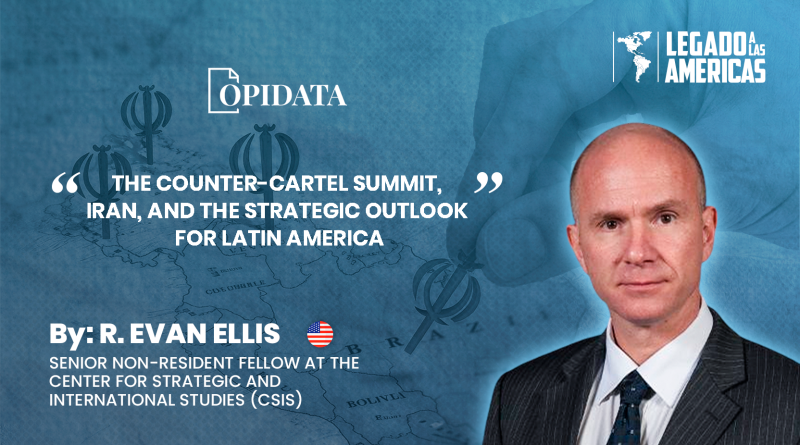
The Counter-Cartel Summit, Iran, and the Strategic Outlook for Latin America
Autor: R. Evan Ellis [1] Specialist in U.S. security and U.S.–Latin America relations
An analysis of how security, global geopolitics, and competition among major powers are redefining Latin America’s role.
“Never before in recent times has the region been so willing to engage with the US, so tempted by extra-hemispheric actors, so beset by security challenges, and so affected by how events play out in other parts of the world…”
Introduction
The March 2026 Counter Cartel Conference at U.S. Southern Command, and associated meeting of selected Latin America leaders with the U.S. President in Doral Florida, conducted during major U.S. military operations in Iran, highlights the continuing emphasis given by the U.S. Administration to Latin America and the Caribbean.
Although the gatherings did not feature announcements of significant new U.S. resources or programs for the assembled leaders, it showcased a coalition of Latin American and Caribbean governments coming together to emphasize their commitment to collaborate with the U.S. on security and other issues. Reciprocally, for the U.S., the dedication of time to the event by the U.S. President and Secretary of War in the middle of complex and critical Iran operations provides evidence of the Administration’s continuing attention to the Western Hemisphere, as expressed in its December 2025 National Security Strategy (NSS), and the January 2026 National Defense Strategy, in spite of the dedication of substantial resources and focus to Iran operations.
Collaborative ground operations between the US and Ecuadorian armed forces in the latter country in early March 2026, also planned and conducted while the Iran operations go on half a world away in Iran, similarly demonstrate this commitment.
The Character of Continuing U.S. Prioritization of the Western Hemisphere
U.S. security activities in Latin America in the coming months are likely to reflect a relatively unprecedented U.S. pragmatism and disposition to military action in and commercial deals with the region, complemented by the desire of a historically large and diverse group of governments in the region for positive engagement with the U.S., albeit for a range of reasons from alignment of values, to interest, to fear of the consequences of not having a positive relationship with Washington.
On the U.S. side, the U.S. Administration approach to the region, expressed in the NSS, emphasizes a disposition to dedicate more U.S. military resources in the region, with a focus on the control of borders, and operations against cartels, using lethal force where necessary. It also announces a new pragmatism in the governments with whom it is disposed to work, not disqualifying partners due to their authoritarian character, corruption, social policies, or accusations of human rights violations. The NSS further indicates that the U.S. will use military incentives and commercial deals to attract new partners, while deemphasizing, albeit not abandoning traditional social and developmental programs.
The NDS, which includes a discussion of the Western Hemisphere within the section on the homeland, builds on the U.S. intention, announced in the NSS, to assure U.S. access to strategic terrain in the wake of encroachment by extra-hemispheric rivals. The NDS specifically names its southeastern maritime approaches and Panama (critical transit routes in US support for a war in the Indopacific), as well as Greenland, as examples of such terrain.
A Region Disposed to Cooperate with the U.S. For Its Own Reasons
Complementing U.S. interest to “enlist and expand” a coalition of willing partners on security and commercial issues, a historically large and growing number of governments in the region are open to such engagement, for a variety of reasons.
The core group of such governments are those with generally right-of-center orientations which have openly supported U.S. military operations in Venezuela and Iran. These were, with few exceptions, the leaders invited to attend the Counter Cartel conference and meeting with the U.S. President in Doral, and who committed there to join with the U.S. in using military force, among other instruments, against the cartels.
This core group arguably includes the Javier Milei government in Argentina, Santiago Peña’s government in Paraguay, that of Daniel Noboa in Ecuador, the just inaugurated Jose Antonio Cast government in Chile, the Louis Abinader government in the Dominican Republic, that of Kamla Persad-Bissessar in Trinidad and Tobago, Laura Fernandez in Costa Rica, Nasry Asfura in Honduras, and to some degree, Jose Raul Molino in Panama.
Each of this core group has strong, although often different, reasons to seek close relations with the U.S. Administration, from values alignment to political expediency. Most came to power for reasons not explicitly related to the appeal of current U.S. policies, but rather, due to their citizens’ concerns over insecurity, corruption, and fear of alternative far-left populists or Communists taking power.
Possible additions to this core group may occur with likely conservative victories in elections upcoming elections in Peru and Colombia. In Peru, the first round of that country’s April 12 elections will likely be dominated by politically right candidates Rafael Lopez Aliaga and Keiko Fujimori, probably ensuring a right oriented government whoever wins. In Colombia, Round One of that nation’s presidential elections on May 31st are likely to lead to one of two right-oriented candidates facing off against leftist Ivan Cepeda and beating him: Abelardo de la Esprilla or Paloma Valencia.
Beyond this core group, Mexico, Guatemala, and Brazil each have left-leaning, albeit democratic governments which are cooperating with the U.S. and restraining criticism of U.S. foreign policy to varying degrees, arguably to avoid repercussions.
In Mexico, leftist President Claudia Sheinbaum is negotiating the renewal of the U.S.-Mexico-Canada Free trade agreement, seeking to avoid its derailment in conflict with the U.S. over other issues, an outcome which could unchain Mexico economically and politically from its integration into the North American economy, with disastrous consequences for both the country and its neighbors. The importance of avoiding such a catastrophe, as well as past U.S. Administration threats to impose tariffs on the country, has arguably played a role in Mexico’s substantial security cooperation with the U.S., including extraditing 92 criminals detained in Mexico to the U.S. since the beginning of the current U.S. Presidential Administration. Mexican cooperation also includes the Sheinbaum’s takedown of multiple key cartel leaders, most recently Nemesio Oseguera Cervantes (“El Mencho”), despite generating significant violent reprisals by his cartel, Jalisco Nueva Generacion (CJNG) across the country.
Bernardo Arevalo’s government in Guatemala has similarly cooperated with the U.S. on a range of migration and extradition issues, even though his Samia party has a very different political orientation than the current U.S. administration. One major driver of this disposition has arguably been Arevalo’s perception of vulnerability to the Guatemalan right, which has long sought to block or remove him, and his Semilla party, from office.
In Brazil, the government of Luis Ignacio “Lula” de Silva, Lula, has inadvertently become the greatest counterpoint to US strategic interests in the hemisphere. Brazil is the biggest recipient by far of PRC investment, PRC military activity, partnership with states hostile to the US including the PRC, Russia, and Iran through the BRICS forum. Its justice system has jailed and politically inhabilitated former Brazilian President on charges that the current U.S. Administration has questioned and responded with sanctions. Still, as Lula’s leftist Workers Party (PT), faces October 2026 national elections in a virtual tie against Bolsonaro’s son Flavio, Lula has sought to decrease the conflict with the U.S. Administration. He arguably calculates that his reelection in October 2026 may depend on avoiding a perception of leftist extremism, or that Brazil’s posture is damaging its relationship with the United States.
The most complex category of actors relating to the U.S. in the security domain in the region are arguably its remaining fragile authoritarian regimes.
In Venezuela, Delcy Rodriguez, successor to the illegitimate criminal government of Nicolas Maduro, has been successful in securing the lifting of sanctions and working with the U.S. Administration on deals, legislation and policy changes that give U.S. companies access to the country’s oil and mining resources. Meanwhile, her government has taken symbolic measures to release some political prisoners and change some laws, while not substantially dismantling the country’s repressive apparatus or moving quickly toward democratic elections, let alone recognizing the victory of Edmundo Gonzalez, in the June 28, 2024 elections which the Maduro government (of which Rodriguez was part) openly stole.
The increased resources benefiting the Delcy Rodriguez regime has arguably fortified its position and reduced risks of internal fractures from Chavista rivals such as Defense Minister Vladimir Padrino Lopez and Interior Minister Diosdado Cabello, both of whom arguably distrust Delcy and her brother Jorge Rodriguez. The regime’s limited actions against the criminal activities in the narcotics, mining and other sectors, from which it previously profited, has arguably similarly deferred resistance to Rodriguez’ cooperation from the U.S. from associated groups such as the ELN and Sindicatos, which profit from such activities.
In Cuba, the cut off of Venezuelan and Russian oil deliveries has compounded the problems of a collapsing electric grid, to shut down virtually the entire economy, deepening an already grave economic and humanitarian crisis. An ongoing negotiation between the U.S. administration and the son of Communist Party founder Raul Castro (“Raulcito”), as well as a new U.S. willingness to sell Venezuelan oil to private parties in Cuba, through U.S. companies, could lead to a deal which permits the near-term survival of the Communist Party, while obliging it to substantially cooperate with U.S. wishes, as occurred in Venezuela.
In the short term, the focus of US leadership attention on the war in Iran and its apparent continuation could defer decisive US action to push for political transition in Venezuela, or to finalize a deal with Cuba, although the U.S. Administration could easily return to such Latin American matters even while its military engagement in Iran remains at a high level.
Security Challenges in the Region
Although the U.S. deployment of substantial military assets and the conduct of lethal strikes against drug boats has temporarily deterred a substantial number of such transits, the region continues to face enormous and evolving challenges from transnational criminal organizations. Insecurity associated with such activities has been a leading factor in virtually all political contests in the region, including recent election in Costa Rica and Chile, and ongoing electoral campaigns in Peru and Colombia.
Led by expanding cocoa production in Colombia, cocaine production has diversified across the region including expansion into new areas in Peru, Bolivia, and Venezuela, and even to non-traditional producers such as Guatemala and Honduras. It remains to be seen whether greater U.S. cooperation with new governments in Venezuela and Bolivia–and possibly with Peru if the current election leads to a shift to the right there–will substantially change that trajectory.
Beyond cocaine, synthetic drug production, principally through Mexico, is taking off, leveraging relatively easy access by Mexican and other groups to precursor chemicals manufactured in China. Synthetic drug production is also harder to combat because it does not involve the growing of plants that can be observed and eradicated, such as crops of coca or heroin poppies.
Increased demand for cocaine and synthetic drugs from Europe has fueled the entry of European criminal groups into the region as facilitators and financiers. These include Italy’s Ndrangheta, and the Albanian mafia, both of which who work with Mexican, Colombian, and Brazilian based gangs among others. Chinese criminal groups are similarly involved in a variety of illicit activities in the region.
In addition to drugs, the illegal mining industry is also expanding rapidly in Latin America, fueled by gold prices of almost $5,000 an ounce, fueling expanded illicit production from Peru, to the interior of Suriname and Guyana, to the Orinoco basin in Venezuela.
Substantial revenue from criminal activities in the region, combined with commercial and other technology advances, has helped to put a range of new capabilities in the hands of cash-flush criminal groups, which use them for nefarious, often lethal purposes. Such capabilities include drones, which are increasingly used for observation, smuggling, and for attacks against rival groups, civilian populations, and even governments, from the Mexican state of Michoacan to Colombia, to Ecuador, among others. Criminal groups also have increasingly used sophisticated, encrypted communications technology and other capabilities to securely communicate and coordinate global operations. Criminal groups have similarly employed artificial intelligence and other advanced tools for cybercrime and other operations. They also increasingly use cryptocurrencies to facilitate the transfer of wealth across international boundaries without having to physically move cash.
The expansion of PRC-based companies, financial institutions and networks, and the growth of business relationships with PRC-based companies and individuals in the region has facilitated activities by Chinese criminal groups, as well as the use of Chinese companies, financial institutions and trade flows for money laundering and other illicit activities in ways that are difficult for Latin American law enforcement to follow.
Potential Impacts of Current Global Events on Latin America
In a Latin America already under considerable stress, U.S. military activities in Iran will likely put additional economic and political stresses on the region. Iran’s use of asymmetric tactics, including its decentralization of leadership, and proliferation and dispersal of low-cost attack capabilities such as drones, has arguably succeeded in prolonging the conflict and increasing its global economic impacts.
The prolonged de facto closure of the Straits of Hormuz, through which about 20% of the world’s oil flows, has substantially increased the price of petroleum, as well as other products produced in Persian Gulf states including fertilizer, a key input for agricultural production, and also mostly trapped now inside the Gulf. The key driver is not the destruction of the majority of Iran’s military capability, including missile launchers and mine-laying boats, but rather, its ability to maintain a credible threat of at least some attacks, obliging the majority of commercial ships not to risk the transit, and insurance companies not to underwrite them if they do.
Central American and Caribbean states dependent on oil imports are likely to be particularly hard hit, but the increase in petroleum prices will also put political economic and political stresses on marginal populations throughout the region, as occurred when Russia invaded Ukraine in February 2022. This includes likely price increases for gas for cooking, and oil to heat homes, as well as transportation fuels for taxi drivers and truck drivers who must purchase such items out of their own earnings. Increased fertilizer costs, and greater diesel fuel prices for the vehicles that plow fields, harvest crops, and transport them to market, will all put upward pressure on food prices in the region, disproportionately harming economically vulnerable populations and creating political pressures on government to protect them through subsidies and other compensation.
As the U.S. continues to focus on Iran, that attention may also detract from the ability of senior leadership to plan and implement initiatives that actively push back against the more subtle forms of Chinese influence in Latin America, which generally come from PRC economic and people to people engagement. Indeed, with the previously noted likely increases in petroleum and food prices, the PRC is likely to expand its activities in the region to acquire such goods, and invest to give its own companies a foothold in their supply. Key beneficiaries of such expanded purchases at elevated prices, and possible increased investments will likely include Brazil, which is both a major oil and agricultural producer. Other Southern Cone states such as Argentina and Uruguay are likely to benefit as well.
Beyond commodities, a sustained increase in petroleum prices is also likely to accelerate China’s supply of renewable energy production capabilities to the region, particularly hydroelectric wind and solar energy, as well as electric vehicles and the products and capabilities that support each, which PRC-based companies increasingly dominate.
Beyond direct commercial effects, as US support for Latin American institutions and training and other charitable programs is diminished, Latin America is likely to continue to send to take advantage of Chinese offer is to bring a wide range of students and professionals over to the PRC for training, including politicians, Congresspeople, military and police personnel, think tank scholars, journalists, and others, as outlined in China’s December 2025 Policy White Paper on Latin America and the Caribbean, as well as in its May 2025 China-CELAC strategic plan.
In the military domain, sustained US engagement in Iran, particularly if the PRC perceives that the US has used up a substantial portion of its air defense munitions and other precision munitions, could tempt an economically besieged China, at the end of XI Jinping’s unprecedented third term, to act against Taiwan to put an end to its autonomy once and for all. President Xi might be tempted to take such action calculating that the US will lack the military resources and attention to effectively respond. China might, of course, be constrained from taking such a risk due to multiple purges to its military, including the recent elimination of Zhang Youxia. These collectively suggest significant internal divisions and corruption that may have impacted military readiness. President Xi might also calculate that the U.S. military capabilities demonstrated in both Iran and Venezuela, as well as the potential for significant economic disruptions with China already hurt by elevated oil prices, argues against taking such a risk.
If, despite such calculations, the PRC does seek to take advantage of U.S. distraction and the depletion of its precision munitions through the Iran campaign, at best, for Latin America, such a conflict would create major supply disruptions and even risk a global financial crisis. Even escalation to nuclear war is not unthinkable. Even if the war remained conventional, some portion of it would likely play out in the Western Hemisphere, as the PRC and its partners sought to disrupt U.S. resupply lines through the Caribbean and Panama Canal, leverage access to Western Hemisphere space, or launch attacks against the U.S. homeland.
Conclusion
The new U.S. attention to security engagements in the Western Hemisphere is welcome, and is likely to be persistent, even in the wake of demands from other regions such as Iran. Ironically, never before in recent times has the region been so willing to engage with the US, so tempted by extra-hemispheric actors, so beset by security challenges, and so affected by how events play out in other parts of the world from the Middle East to the IndoPacific.
[1] About the author: R. Evan Ellis is a Senior Non-Resident Fellow at the Center for Strategic and International Studies (CSIS) and a leading specialist on security, organized crime, China, and geopolitics in the Western Hemisphere. The author is Latin America Research Professor with the U.S. Army War College. The views expressed herein are strictly his own, and do not necessarily represent his institution or the U.S. government.
🌎 Spanish version available here:
This article is part of Opidata, the editorial platform of Legacy to the Americas for the analysis of key issues in the region.
🔍 More content at 👉 https://legadoalasamericas.org
📩 To receive new articles, subscribe to our newsletter or follow us on social media.